Mux Expands Video Intelligence Toolkit with Open-Source and Self-Hosted LLM Support

Video infrastructure platform Mux has officially rolled out native support for open-weight and self-hosted Large Language Models (LLMs) within its @mux/ai toolkit, marking a significant departure from its original hosted-only ecosystem. The update introduces first-class integration for Baseten and a universal OpenAI-compatible provider. This allows developers to route video intelligence workflows—such as automated tagging, visual question-answering, and content moderation—through their own custom inference infrastructure, local environments, or fine-tuned proprietary models.
When Mux initially launched the @mux/ai toolkit in December of the previous year, it debuted as a Bring-Your-Own-LLM (BYO-LLM) solution designed to grant customers strict governance over which third-party providers processed their video assets. However, the architecture was inherently restricted to major hosted commercial ecosystems, primarily OpenAI, Anthropic, and Google. While this satisfied many standard applications, it alienated enterprises bound by strict data residency policies, as well as engineering teams operating proprietary self-hosted models on dedicated hardware. The latest update bridges this gap, enabling widespread flexibility for organizations seeking total sovereignty over their video processing pipelines.
The Evolution from Custom Forks to First-Class Support
The catalyst for this architectural pivot originated earlier in the year within Mux’s own engineering division. In May, Joshua, a member of the company’s Community Engineering team, sought to experiment with video intelligence workflows without incurring accumulating token costs for every iteration. To achieve this, he engineered a custom fork of the @mux/ai repository. He integrated Ollama for local experimentation, paired it with Baseten to train and host a Low-Rank Adaptation (LoRA) fine-tune of Mistral Small 3.1, and wired the custom model directly into the SDK’s internal workflows.
While the resulting internal experiment proved successful—yielding concise, highly customized video summaries tailored to specific enterprise requirements—it highlighted a structural limitation: developers were forced to maintain custom forks of the SDK to utilize self-hosted or open-weight models. Recognizing a broader market demand driven by the rapid advancement of open multimodal architectures, Mux product teams formalized the experiment into a supported upstream feature.
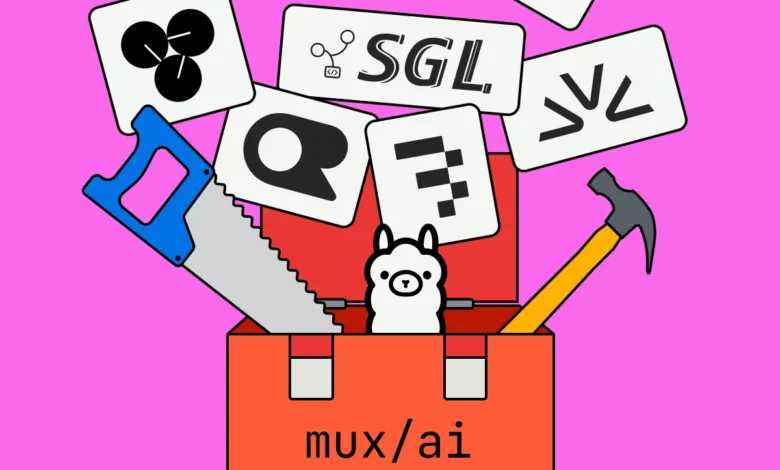
The breakthrough came as engineering teams realized that building a targeted integration exclusively for Baseten’s infrastructure naturally unlocked a much wider ecosystem. Baseten’s Model APIs, alongside industry-standard inference engines such as vLLM, SGLang, Ollama, Together AI, and Fireworks AI, universally adhere to the OpenAI-compatible chat completion protocol. Consequently, Mux engineers designed a single, general-purpose openai-compatible provider capable of interacting with any endpoint speaking the OpenAI protocol, complemented by a specialized Baseten preset layer designed to validate endpoint configurations and surface precise diagnostic errors.
Technical Implementation and Configuration
Configuring the newly supported providers follows a standardized schema consistent across the entire @mux/ai toolkit. Developers must specify a base URL, an API key (which can remain omitted for local, unauthenticated endpoints like Ollama), and a designated model identifier.
For local development environments utilizing tools such as Ollama running models like Qwen3-VL, configuration requires defining environment variables such as OPENAI_COMPATIBLE_BASE_URL and OPENAI_COMPATIBLE_MODEL. Once configured, standard workflow functions—such as getSummaryAndTags—operate seamlessly without requiring changes to the underlying application logic. Similarly, routing requests through managed platforms like Baseten to utilize specialized architectures, such as Moonshot AI’s Kimi K3 for automated content moderation pipelines, requires only specifying the provider and model parameters within the workflow call.
Unlike hosted commercial APIs where default fallback models are standard, self-hosted and BYO-endpoint configurations require explicit model declarations. Because Mux cannot inherently predict the specific weights or hardware constraints deployed on customer-managed clusters, developers must explicitly pass model arguments either via code parameters or environment variables.
Navigating Technical Nuances: Vision Capabilities and Reliability
Integrating open-weight models into advanced video workflows introduces distinct technical hurdles compared to standard text-based chat applications. Mux’s architecture relies on four core vision-capable workflows: getSummaryAndTags, askQuestions, hasBurnedInCaptions, and generateEngagementInsights. These workflows extract visual data by generating storyboards and supplying remote URLs to the underlying model endpoint.
However, certain local inference runtimes, such as Ollama, historically lack the ability to fetch external URLs passed via standard image_url parameters. To accommodate these limitations, Mux incorporated an imageSubmissionMode: "base64" configuration option, allowing the SDK to inline image payloads directly and significantly expanding the catalog of compatible local models. Furthermore, because these workflows depend on structured outputs via response_format: json_schema to deliver typed, programmatically usable results, endpoints lacking robust JSON schema enforcement will fail safely rather than emitting malformed data.
Text-centric workflows—including generateChapters, translateCaptions, and editCaptions—exhibit far greater leniency, operating smoothly across almost any text-only open model featuring structured output capabilities and an adequate context window, such as DeepSeek V4 or gpt-oss variants.
To mitigate trial-and-error overhead for engineering teams, Mux has published comprehensive documentation outlining verified vision models, alongside a dedicated validation utility (verify-vision-models.ts) that tests live endpoints against required schema and vision constraints prior to production deployment. Mux explicitly notes that performance evaluations, cost estimations, and latency benchmarks cannot be natively calculated for self-hosted hardware, placing the burden of qualitative evaluation firmly on the deploying organization.
Field testing conducted during the development phase also exposed subtle reliability differences between proprietary and open-weight models. For instance, testing with Inkling variants revealed occasional edge cases where roughly one in twelve requests degenerated into output truncated prematurely at token caps, leading to schema validation failures. To address this non-deterministic behavior without requiring manual intervention, Mux updated its internal retry mechanism (withRetry) to treat empty or truncated non-responses as retryable events, bypassing content-policy refusals.
Fine-Tuning and Enterprise Implications
The release underscores a broader industry shift toward decentralized, specialized AI infrastructure. By enabling native integration with custom fine-tunes—such as Joshua’s original LoRA-tuned Mistral Small 3.1 model optimized for synthetic video intelligence datasets—Mux empowers organizations to transition away from generic, costly off-the-shelf APIs toward domain-specific models trained on proprietary data repositories.
From an economic and security standpoint, the implications are profound. Enterprises bound by stringent data governance frameworks, healthcare compliance, or media confidentiality agreements can now process high-value video assets entirely on-premise or within isolated virtual private clouds, ensuring video frames never traverse external commercial APIs. While self-hosting eliminates predictable per-token SaaS pricing in favor of fixed GPU infrastructure expenditures, it requires internal engineering bandwidth to manage scaling, monitoring, and model validation.
Availability and Community Involvement
The updated @mux/ai toolkit is available immediately as an open-source project licensed under the Apache 2.0 license. Developers can install the package via standard node package managers using npm install @mux/ai.
Mux has encouraged the developer community to contribute verified configurations, documentation updates, and pull requests for newly tested open-weight models as the broader multimodal ecosystem continues to evolve. Through this release, Mux positions its tooling not merely as a bridge to dominant commercial AI labs, but as a flexible, infrastructure-agnostic framework built for the modern era of open-weight artificial intelligence.